
HEALTH JOURNAL
Managing Achilles Pain Without Applying the Same Heel Drop to Everyone
Dr. Wei (Sean) Li · · Updated
Achilles tendon pain is usually managed by identifying the problem, adjusting aggravating activity, and progressively rebuilding calf-and-tendon capacity. The location matters: pain where the tendon joins the heel needs different exercise choices from pain farther up the tendon. A sudden pop with loss of push-off is a different situation and needs prompt assessment for rupture rather than a routine tendinopathy workout. AAOS Achilles guide
On this page
Insertional and midportion are not interchangeable labels
Insertional symptoms occur at the heel attachment. Midportion, or noninsertional, symptoms occur above that attachment. Shoes, recent changes in walking or running, and the examination help place the symptoms in context. The label 'tendinitis' does not mean every painful tendon needs the same stretch. AAOS Achilles guide
The Achilles tendon connects the calf muscles to the heel bone. It transfers their force when you push off to walk, climb stairs or rise onto your toes. Repeated loading that rises faster than your current capacity can make these tasks painful. Rehabilitation therefore has two connected aims: settle the activities that repeatedly irritate the area, then rebuild the strength and tolerance needed for your daily or sporting demands. AAOS explains the tendon’s role and common triggers.
The 2024 American physical therapy guideline addresses midportion Achilles tendinopathy. It recommends progressively loaded exercise to improve pain and function, with the load selected according to tolerance and tendon safety. Complete rest is not the usual plan for this condition. A rupture, a repaired tendon or another heel diagnosis requires its own approach; this is not a postsurgical protocol.
Reduce the repeated irritation without losing the whole day
The first adjustment is often how much activity you do at once. Hills, jumping, faster running or a sudden rise in daily steps may be more provocative than a shorter level walk. Temporarily reduce the activity that repeatedly worsens symptoms while keeping suitable movement in the day. That can create room for a more tolerable rehabilitation plan. AAOS describes activity modification.
That does not mean a low-impact activity is suitable for every person. The response still needs review. Record the relevant task: morning walking, stair use, or the distance at which symptoms increase. This makes change visible without turning every step into a pain test.
Why an off-step heel drop can be the wrong starting point
Lowering the heel below a step bends the ankle farther toward the shin. At the heel attachment, that position can press the tendon against the heel bone as well as load it in tension. AAOS restricts its off-step heel-drop routine to noninsertional symptoms. An exercise that suits pain farther up the tendon can therefore be the wrong starting version for pain at the attachment.
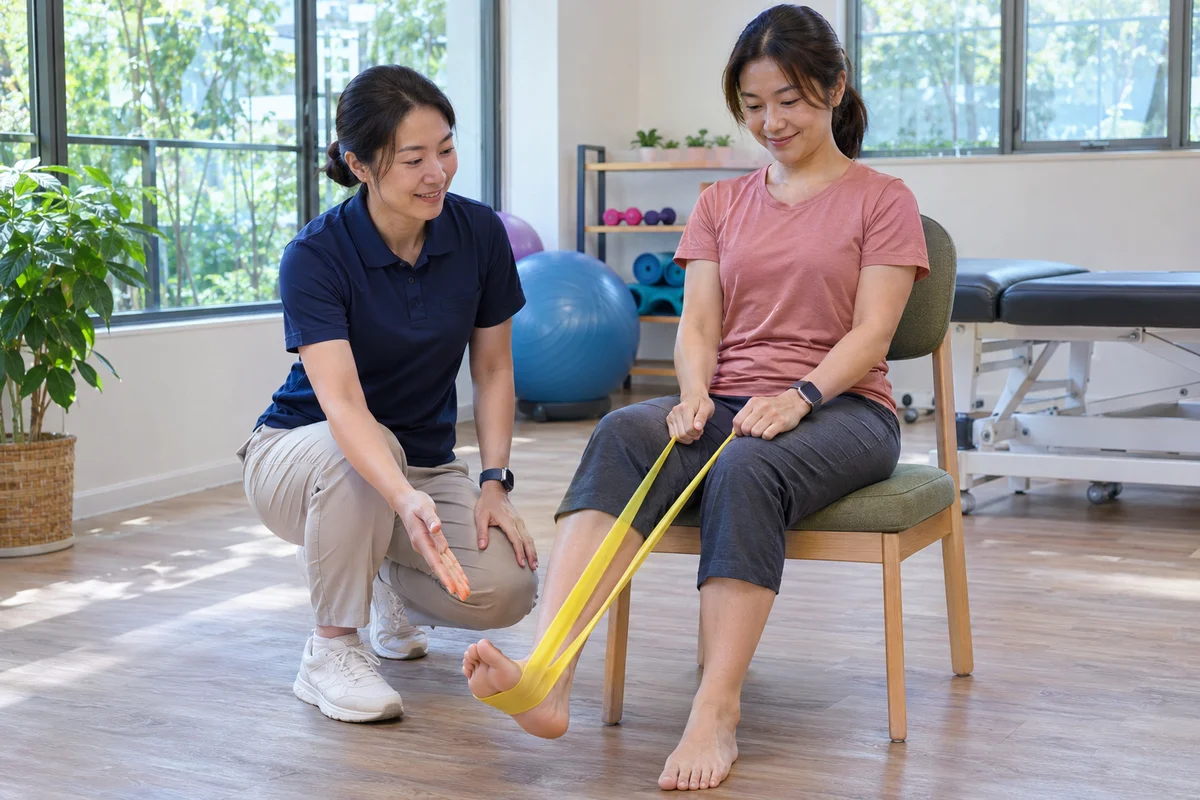
A therapist selects the starting range, support and resistance, demonstrates the movement, and checks that you can reproduce it. A calf raise uses the calf muscles to lift the heel; slowly lowering it keeps the muscles working as they lengthen. This builds capacity against a load, while a stretch mainly works on movement range.
The selected version may limit how far the heel lowers. Progress can change resistance, repetitions or later task speed, with the response checked rather than aiming for the most painful version.
In a 2025 Belgian randomized trial, 42 sport-active adults with insertional symptoms lasting more than three months received one of two progressive rehabilitation programs. The program that limited ankle bending toward the shin, omitted calf stretching and used heel lifts improved pain-and-function scores more than the higher-compression program. The between-group advantage was 12.9 points at 12 weeks and 10.4 at 24 weeks on a 100-point scale, where higher scores meant better function.
Those results concern a package of supervised exercise, education and other measures. They support choosing the loading position thoughtfully; they do not isolate one heel lift or exercise as the reason for improvement, or set a personal return-to-sport date.
Relief and return to running are separate milestones
Comfortable walking is useful progress, but running and jumping add greater and faster loads. The later plan needs to build toward those demands. Reassessment can compare walking or stairs, calf-raise control and capacity, and the next morning’s pain or stiffness under similar conditions. Increase one demand at a time. A calendar date alone cannot show readiness; symptoms that repeatedly worsen after a training change call for review of the activity amount and diagnosis.
Sudden marked weakness, inability to push off, or a new injury changes the pathway. Do not repeatedly test a suspected rupture with heel raises. A repaired or medically managed rupture follows its own protection and loading instructions.
Connect the exercise to your walking or sport goal
At Wongs Acupuncture & Angel Alliance Physical Therapy, physical therapy can connect the pain location and examination to a practical loading plan and daily mobility goals. An acupuncture consultation can review symptom-care options alongside rehabilitation. It should not promise immediate tendon repair or replace assessment of a possible rupture.
OUR LOCATIONS
Choose a clinic.
Choose a convenient location to discuss your needs or arrange a visit.