
HEALTH JOURNAL
ACL Injury and Physical Therapy: Care Paths and Progress
Dr. Wei (Sean) Li · · Updated
Physical therapy after an anterior cruciate ligament injury aims to rebuild useful knee movement, strength and confidence in activity. The plan depends on knee stability, associated injuries and what you want to return to. Some people follow a nonsurgical pathway; others have an operation and need rehabilitation that protects the procedure. Those paths should not share one automatic exercise schedule.
The anterior cruciate ligament, or ACL, helps control forward movement and rotation of the shinbone relative to the thighbone. This guide concerns adult care planning, not a pediatric program, a surgical protocol or clearance for unrestricted sport.
On this page
- What should be clarified after an ACL injury?
- Can physical therapy be used without ACL surgery?
- What changes after ACL reconstruction or repair?
- What are the exercises meant to improve?
- How should you use the home program?
- How long does recovery with physical therapy take?
- What information makes follow-up useful?
- Which changes need prompt medical attention?
- How can you choose a suitable PT appointment?
- Prepare for the next stage of care
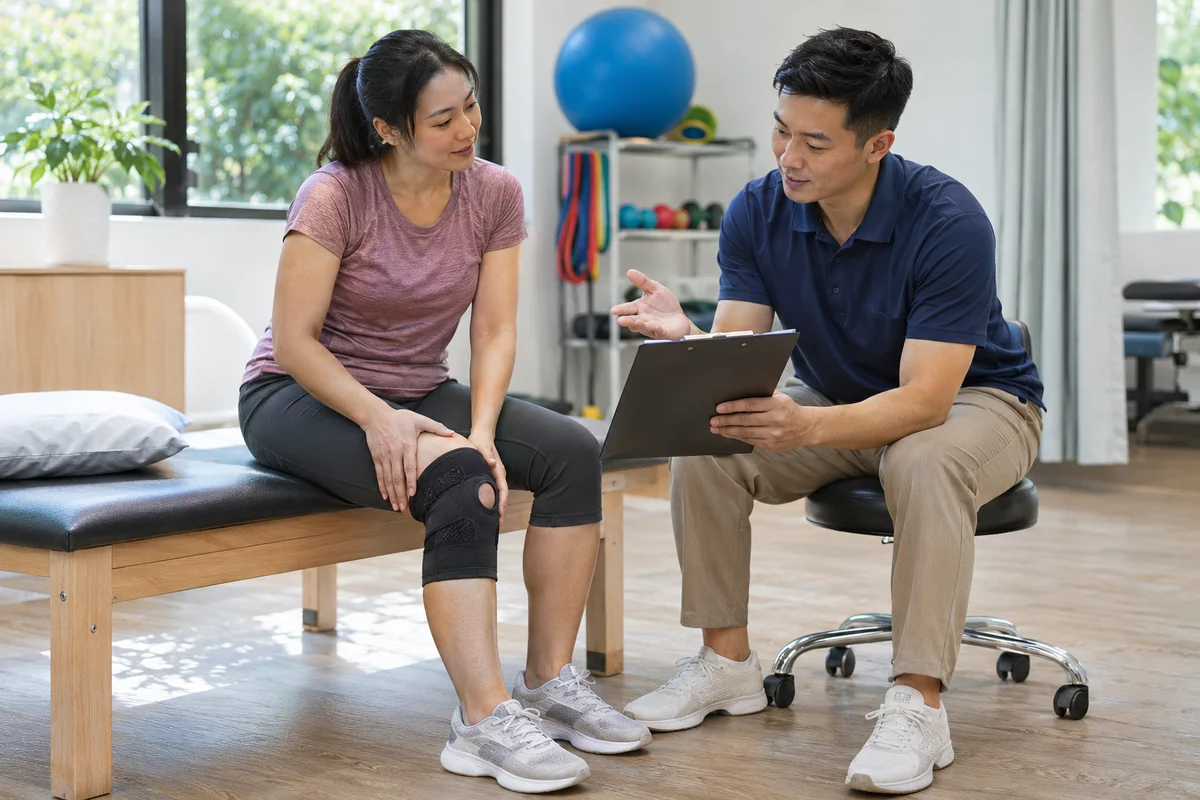
What should be clarified after an ACL injury?
Describe how the injury happened, swelling, any episodes of giving way and the activities you cannot manage. The examination and relevant imaging help establish the injury and whether the meniscus, cartilage or another ligament is involved. Pain alone does not show how stable the knee is during a turn or a sudden change of direction.
The diagnosis and instructions identify partial or complete tearing, associated injuries and current protection needs. A coexisting meniscus injury remains relevant. Our meniscus injury guide addresses that different tissue problem; rehabilitation after meniscus repair follows its own surgical instructions.
Can physical therapy be used without ACL surgery?
Yes, for some people. The AAOS ACL injury guide describes nonsurgical management that includes rebuilding front-thigh (quadriceps) strength and confidence through PT. The decision depends on your needs and goals, not just the word tear.
Some people with partial tears, and selected people with complete tears, can manage appropriate activities without reconstruction. Repeated instability, pivoting demands, associated injuries and the person’s preferences influence the orthopedic discussion. HSS patient information distinguishes those choices and the possibility of instability during twisting activities.
A nonsurgical plan can work on strength and activity demands, but feeling better is not proof that every torn ligament has returned to its original structure. Tell the treating team if the knee continues to give way rather than repeatedly testing it with the movement that caused the problem.
What changes after ACL reconstruction or repair?
The exact operation matters. In reconstruction, a tendon graft takes the place of the injured ACL; repair works with the injured ligament tissue in selected cases. The AAOS treatment guide explains the distinction. The search phrase “ACL replacement” does not mean a knee joint replacement. The operative report and surgeon’s instructions identify weight-bearing limits, permitted motion, brace use and additional meniscus or cartilage procedures.
After reconstruction, exercises must respect healing and protection requirements while addressing motion, muscle function and daily activity. Do not substitute an online protocol for the actual instructions or apply a reconstruction program to a repair without checking.
The 2023 Aspetar rehabilitation guideline concerns ACL reconstruction and places exercise at the foundation of rehabilitation. Progression depends on the stage of recovery, symptoms, examination and functional performance. A postoperative program should not be copied unchanged to every ACL injury or used as a universal discharge timetable.
What are the exercises meant to improve?
Nonsurgical care may emphasize rebuilding leg strength and capacity for the activities selected with your team. After reconstruction, moving within permitted limits and learning to tighten the thigh muscles come before progressively more demanding strength work. All of these must fit the operation’s restrictions. Later demands can be very different from early walking.
| Area to review | Assessment and plan |
|---|---|
| Knee movement | Identify the limited direction and the range currently allowed by injury or surgical restrictions. |
| Muscle function | Assess the strength and movement control needed for the next task. |
| Walking and everyday activity | Select support and an amount of activity that fit current protection requirements. |
| More demanding activity | Reassess strength, control and relevant task performance before running, jumping or changing direction. |
Being able to walk comfortably is useful progress. It does not establish readiness for a pivoting sport. The therapist should explain which ability is being practiced and what would justify increasing its demand.
What can selected early exercises look like?
A 2024 US review of ACL reconstruction rehabilitation includes gentle thigh-muscle contractions and heel slides among early home exercises. These examples need approval for your operation and associated injuries. The therapist sets position, permitted range, hold, repetitions and frequency; do not transfer a reconstruction program to a repair or force past a surgical limit.
- For a selected thigh-muscle contraction, sit or lie with the leg supported in the position taught by the therapist. Gently tighten the muscles at the front of the thigh while keeping the leg still, hold for the prescribed time, then relax. The goal is to regain the ability to activate those muscles, not to press harder through pain.
- For a selected heel slide, lie on your back with the leg supported on the bed. Slide the heel toward you to bend the knee only within the agreed limit, then slide it back slowly. Use the assistance taught by the team if needed; do not pull farther to reach an online target.
The contraction practices muscle activation; the slide practices permitted knee movement. Neither demonstrates readiness to run or turn. Later strengthening adds suitable resistance, while balance and task practice train control under progressively greater demands. New giving-way, persistent swelling or a harder everyday task calls for review, rather than simply adding repetitions.
How should you use the home program?
Instructions specify the selected exercise version, range, resistance, repetitions and frequency. The therapist demonstrates unfamiliar movements, then observes you repeat them and explains when to stop or contact the team. Our home-exercise guide explains keeping these details together.
Include walking, stairs, work and training when describing the day’s load. A home program should be reviewed if it is impractical, repeatedly increases symptoms or conflicts with new surgical instructions. Change the plan with the treating team rather than adding exercises from several unrelated protocols.
How long does recovery with physical therapy take?
There is no single duration that covers nonsurgical care, reconstruction, repair and associated injuries. Early recovery of walking and movement is a different milestone from returning to a demanding sport. The operation, healing requirements, strength, function and activity goals all affect the decisions.
For a concrete postoperative reference, HSS patient information describes return to sports after ACL reconstruction as usually taking 9–12 months, depending on the sport, competition level and PT progress. That is a sports milestone, not the length of every PT course or clearance at month nine. The number and spacing of visits change with need; daily activities can recover earlier, while demanding sport may need longer and further assessment.
Aspetar recommends ability-based progression while respecting minimum healing and protection times after reconstruction. Time alone is insufficient, and one passed test does not erase biological requirements. Each next milestone has an assessment and remaining activity restrictions.
The guideline’s proposed sport criteria include a high-demand athlete context and are not a self-clearance checklist. A decision to resume running or pivoting should include the appropriate treating professionals, rather than depend only on a calendar date or the absence of pain.
What information makes follow-up useful?
Report movement, swelling, strength, walking and episodes of instability separately. Explain which activity was attempted and how the knee responded afterward. If function is not improving, the next step may be to adjust the workload, clarify restrictions or reconsider the care path.
Neither surgery nor a period of PT guarantees return to every previous activity. A useful review keeps the remaining limitation and the patient’s goals visible, with a clear reason to continue or change treatment.
Which changes need prompt medical attention?
A newly locked knee, marked swelling, inability to move or bear weight, or a red or hot knee with fever needs urgent medical assessment. The NHS knee-pain guidance treats these as reasons to seek urgent help, rather than try another exercise.
After surgery, follow the team’s wound and clot-prevention instructions. New unexplained calf or leg pain, or one-sided leg swelling, can indicate a blood clot and need urgent assessment. Leg pain or swelling accompanied by shortness of breath or chest pain needs emergency care. The NHS DVT guidance describes this distinction.
How can you choose a suitable PT appointment?
Rehabilitation reviews the diagnosis or operation, follows treating-team restrictions, reassesses movement and strength, and teaches a usable home plan. Travel, access and support also matter. A nearby appointment must fit the stage of care; a clinic listing does not establish a specialist sports-clearance program.
Prepare for the next stage of care
Wongs Acupuncture & Angel Alliance Physical Therapy offers physical therapy in Manhattan, Forest Hills and Great Neck. Bring relevant reports and restrictions. For a pain concern, a separate acupuncture assessment can also be discussed alongside the rehabilitation plan.
OUR LOCATIONS
Choose a clinic.
Choose a convenient location to discuss your needs or arrange a visit.