
HEALTH JOURNAL
Private Pilates in NYC: Movement, Strength and Rehabilitation Goals
Dr. Wei (Sean) Li · · Updated
Private Pilates is one-to-one exercise instruction built around controlled movement, breathing and an individual’s goals. It can give a beginner time to learn technique and allow a more experienced participant to work on a specific movement challenge. When pain, an injury or surgery is part of the picture, the first question is whether you need a physical therapy assessment and how Pilates should fit into that plan.
At Wongs Acupuncture & Angel Alliance Physical Therapy, private Pilates is offered in Manhattan and Great Neck. This guide explains what a private session can involve, how mat and reformer work differ, what the evidence says about back pain, and how to choose useful goals without assuming that a particular exercise method suits everyone.
On this page
- What is Pilates, and what makes a session private?
- Medical Pilates, clinical Pilates and physical therapy
- Mat Pilates versus reformer Pilates
- Can Pilates help lower-back pain?
- What should happen in your first private session?
- How can a program progress without simply becoming harder?
- When should you pause or seek advice?
- How will you know whether private Pilates is worthwhile?
- Planning a Wongs Acupuncture & Angel Alliance Physical Therapy appointment
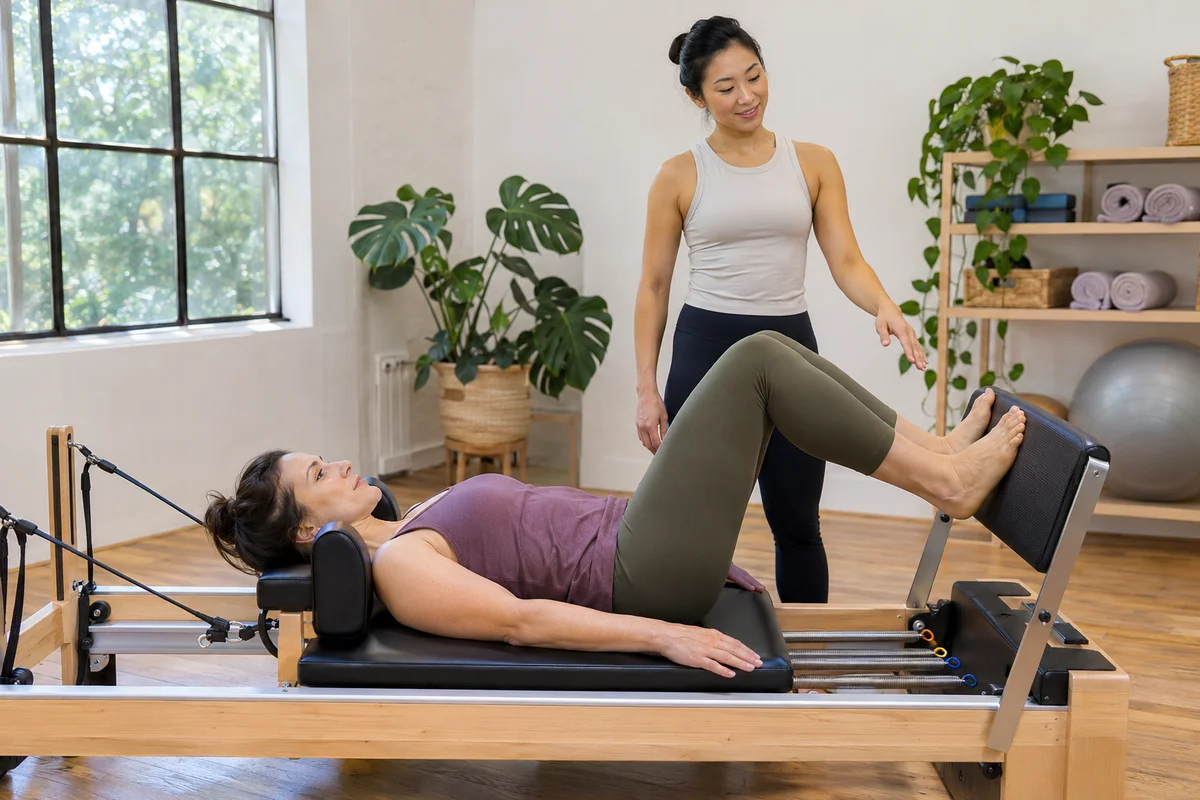
What is Pilates, and what makes a session private?
Pilates emphasizes controlled movement, coordinated breathing and body awareness. Boston Children’s Hospital’s Center for Young Women’s Health describes work involving the abdominals, lower back, hips and buttocks, with strength, flexibility and coordination goals. Exercises may use a mat, body weight or equipment; the starting level should fit the person.
In a private Pilates class, the instructor’s attention is focused on one participant. That creates an opportunity to ask questions, receive feedback and alter the session around your starting point. It does not guarantee a faster result than a group class. Its value depends on the instruction, your goals, the suitability of the exercises and what you can practice consistently.
For example, you might want to understand how to move your legs while keeping your trunk comfortable, learn an unfamiliar piece of equipment or build confidence returning to a routine. Those are more useful starting questions than choosing the most advanced-looking movement. Good instruction explains what an exercise is for and what you should notice while doing it.
“Core” concerns the trunk and nearby supporting muscles working together, rather than the appearance of a flat abdomen. Control means organizing that support as the arms or legs move, while breathing comfortably and releasing unnecessary effort. HSS’s Pilates program describes individualized movement education coordinated with referring clinicians and therapists.
Medical Pilates, clinical Pilates and physical therapy
Medical Pilates and clinical Pilates are terms used for Pilates-informed exercise with an emphasis on assessment, movement quality or rehabilitation goals. The actual appointment should explain the assessment, service scope and whether the visit is billed as physical therapy, rather than leaving those details to be inferred from a label.
A fitness-oriented session and a physical therapy evaluation can both involve movement, but they answer different questions. Exercise instruction helps you learn and practice selected movements. A PT assessment considers a health-related limitation, relevant history and examination findings, then helps organize an individualized rehabilitation plan. One-to-one instruction is not automatically a clinical evaluation.
If you have pain, a recent injury, a surgical restriction or a diagnosed condition, explain that before booking. Do not use the words medical or rehabilitation as a reason to skip necessary medical assessment. Related information: physical therapy.
| Starting need | How the session is adapted | Useful expectation |
|---|---|---|
| You are healthy and new to Pilates. | Start with basic positions and understandable feedback. | Learn technique before adding complexity. |
| You want individual help with an exercise goal. | Select a specific exercise goal and a review measure. | Practice selected skills rather than a generic advanced routine. |
| Pain or an injury limits activity. | Pain or injury may need PT or other medical assessment before general training. | Clarify the problem and precautions before choosing exercises. |
| You are returning after an operation. | The program follows the surgical team’s restrictions and clearance. | Use the existing medical plan rather than a standard online sequence. |
Mat Pilates versus reformer Pilates
Mat Pilates generally uses a floor mat, body weight and sometimes small equipment. Reformer Pilates uses a specialized apparatus with a moving carriage and adjustable resistance or support. The equipment changes the demands of a movement; it does not establish that the movement is more advanced, more therapeutic or more effective for your particular concern.
On a mat, getting down to the floor or holding a position may be the most difficult part. On a reformer, entering the apparatus, managing the moving carriage or understanding a spring setup may need extra instruction. Tell the practitioner when setup is harder than the exercise itself. A different starting position can be more useful than forcing the original version.
Support and resistance can change how much work a movement requires. More resistance is not always a harder or better exercise, because a particular setup may assist one part of the movement while challenging another.
Wongs Acupuncture & Angel Alliance Physical Therapy’s private Pilates service describes individualized training that may include reformer work, core stability, flexibility, balance and functional movement. Confirm the equipment and format for your appointment. A service description does not mean every session uses every exercise or that a particular apparatus is required.
Can Pilates help lower-back pain?
Pilates may be a useful exercise option for some people with chronic nonspecific low-back pain. Nonspecific means that the pain has not been attributed to a particular serious disease or a single clearly identified structural cause. Findings in that group should not be turned into a promise for every disc problem, new injury or episode of pain traveling down a leg.
A Cochrane review of Pilates for low-back pain reported improvements compared with minimal intervention. It did not identify Pilates as the better choice over other exercise. The included searches ran through March 2014; an additional June 2015 search was not incorporated into those results. The practical choice is a form of exercise that fits your assessment and that you can perform and progress consistently.
A 2023 review of 15 randomized trials involving 973 participants reported improvement in pain and disability in adults with chronic low-back pain compared with minimal intervention. The programs used mat, water or apparatus work, mostly over 6–12 weeks; this is not a fixed local course or proof that every format outperforms another exercise program.
A separate 2023 review of eight trials involving 437 participants examined core-muscle thickness and activation as well as clinical outcomes. Its authors described Pilates as a comparable option to similarly supervised and dosed exercise for core-muscle measures. A muscle measurement, pain score and daily activity are different outcomes. That conclusion should not be presented as proof that every Pilates program is equally effective or better for every person’s pain.
Together, these findings support considering Pilates as one exercise option. They do not identify a single best program for every patient, prove that a weak core causes every back problem or establish that Pilates repairs a disc. Choice should reflect your assessment, preferences, access and ability to continue the program. Our back-pain care guide discusses a wider set of assessment and treatment questions.
What should happen in your first private session?
Arrive with a practical goal and a brief account of your exercise experience. Explain any symptoms, injuries, operations or current medical instructions. Describe what is difficult in everyday life: getting up from a chair, returning to a class, reaching comfortably or tolerating a workday. A specific task helps the practitioner understand what matters to you.
The starting discussion should connect your goal with the movements selected. Range is how far you can move comfortably; strength concerns producing force; control concerns coordinating the movement; endurance concerns repeating or sustaining useful work. A person may need more than one of these. Learning the setup and a manageable range may be more useful initially than completing a long sequence.
For example, limited comfortable range may lead to a smaller or more supported movement. When the range is available but control is difficult, practice may focus on a slower coordinated movement in that range. When quality drops after several repetitions, the amount and rest may need adjustment. These illustrate how findings affect a plan, rather than a standard sequence for every person.
Feedback should be understandable. You might work on position first, then breathing or control. If an instruction increases discomfort or leaves you unsure what to do, say so. The exercise can be explained again or changed.
Clothing should allow comfortable movement. Confirm the session duration when booking. An initial acupuncture or physical therapy visit at Wongs Acupuncture & Angel Alliance Physical Therapy is about 75–90 minutes, but that wording should not be assumed to describe the length of a separate private Pilates appointment.
How can a program progress without simply becoming harder?
Progress can mean understanding a movement better, using less unnecessary effort or performing an everyday task more comfortably. Resistance, range, repetitions and complexity are possible ways to change an exercise. They should be selected around the purpose of the program rather than increased together because a previous session felt easy.
For instance, a practitioner may first help you learn a supported movement, then reduce the support as your control improves. Someone else may work on a larger comfortable range or a task that more closely resembles daily activity. These are examples of programming choices, not a sequence every person should follow.
Explain how the session affects the rest of your day. An exercise you can perform in the room may still need adjusting if it leaves you unable to manage ordinary activities afterward. Report new or worsening symptoms rather than interpreting them as necessary evidence of progress.
Do not improvise reformer springs, unstable supports or resistance-band anchors to reproduce an apparatus exercise. Knowing a simpler movement’s purpose is more useful than copying the appearance of a clinic setup. A home version needs its own technique, amount, frequency, acceptable-response and stop instructions. Report missed practice or unclear movements instead of doubling the next session to catch up.
When should you pause or seek advice?
The NHS beginner-video safety information distinguishes general exercise from treatment aimed at a specific pain condition. It advises professional advice before exercise when health problems, injury, symptoms, recent surgery, pregnancy or uncertainty affect suitability. Individual attention does not remove the need to understand that health context.
Stop a movement that causes pain or makes you unwell, and tell the practitioner what happened. Sharp or spreading pain, new numbness, weakness, dizziness or a marked change from your usual symptoms should prompt reassessment. Severe or sudden symptoms may require medical care rather than an exercise adjustment.
If you already have restrictions from a surgeon or another clinician, bring them. Do not abandon those instructions because an exercise has been described as low impact. Low impact concerns one aspect of loading; it does not guarantee that every position or movement is suitable during recovery.
How will you know whether private Pilates is worthwhile?
Agree on one movement goal and one practical activity to review. The measures do not need to be complicated. You might track how confidently you perform a movement, whether you can use a comfortable range or how easily you manage an ordinary task.
Include how you feel afterward, not just whether you completed the exercise. Body shape or photographs can express a preference, but movement quality, strength and tolerance deserve their own measures; a weight or posture image is not the whole outcome.
| Goal | A useful observation | A review question |
|---|---|---|
| Learn a basic movement. | You understand the setup and can explain its purpose. | Can I practice an appropriate version without guessing? |
| Improve exercise confidence. | You can communicate limits and recognize when to adjust. | Am I becoming more independent? |
| Work on a functional limitation. | A relevant daily activity becomes more manageable. | Does improvement carry over outside the session? |
If the goal is not changing, review the program rather than automatically adding sessions. The exercises, frequency, starting assumption or type of assessment may need reconsideration. There is no universal visit count that proves success. A useful plan tells you what you are working toward and when to reassess it.
Planning a Wongs Acupuncture & Angel Alliance Physical Therapy appointment
Explore private Pilates and choose between the Manhattan clinic and Great Neck clinic. An acupuncture consultation is a separate pain-care option to discuss when appropriate; it is not part of every Pilates program. Contact your preferred clinic to confirm the appointment type and timing.
OUR LOCATIONS
Choose a clinic.
Choose a convenient location to discuss your needs or arrange a visit.