
HEALTH JOURNAL
Occupational Therapy vs. Physical Therapy: Which Assessment Fits Your Goal?
Dr. Wei (Sean) Li · · Updated
Physical therapy (PT) and occupational therapy (OT) both help people function more independently, but they approach that goal through different professional perspectives. PT commonly focuses on movement, physical capacity and related symptoms. OT focuses on participation in the everyday activities you need or want to do, including adapting tasks or the environment. The right choice depends on the obstacle to your activity; some people benefit from both professions.
“Occupational” does not mean treatment only for your paid job. In OT, an occupation can be getting dressed, preparing food, studying, caring for family or another meaningful daily activity. Likewise, PT is broader than sports rehabilitation. Start by describing the task that has become difficult, rather than choosing a profession from the body part alone.
On this page
What does physical therapy focus on?
A physical therapist examines movement-related problems and develops a plan around the findings and your goals. This can involve movement range, strength, balance, walking or activity tolerance—how long you can continue an activity before needing a rest. Pain is relevant, but the plan also considers what you can do and what you need to regain.
These capacities do different work. Movement range affects where you can reach; strength helps with lifting or rising; balance helps control your position; endurance helps you continue or repeat a task. The assessment helps identify which capacity is limiting the activity, so practice can target that obstacle and progress toward the relevant daily demand.
The American Physical Therapy Association (APTA) describes examination, a treatment plan, monitoring and adjustments as parts of the PT role. The profession works with different ages and health conditions, not only athletic injuries.
For example, “I cannot finish my usual walk without stopping” gives an assessment a concrete starting point. The therapist can investigate what limits the task and decide which movement or physical-capacity questions need attention. That is more informative than asking for a standard set of exercises because walking has become difficult.
What does occupational therapy focus on?
The American Occupational Therapy Association (AOTA) describes OT in terms of participation in daily living. Its focus is the activities that matter to the person, rather than paid employment alone.
An occupational therapist may examine how you perform a task, what makes it difficult, and how your abilities, tools, routine and environment interact. The plan may include practicing the activity, learning a strategy or considering an adaptation. The Cleveland Clinic’s patient guide gives examples such as dressing, using technology, taking medication and shopping.
If fastening a shirt is difficult, the useful question is not simply whether the hand is strong. The task also involves handling the fastening, positioning clothing and organizing the steps. An OT assessment can consider the activity as a whole and whether a different technique or tool would help. A proposed adaptation should be checked for your actual circumstances, rather than bought solely because it appears in a general article.
AOTA also includes strategies for memory, concentration and planning when these affect everyday participation. For example, an OT plan may address remembering and organizing the steps of a routine, alongside a change to the task or environment. Family or caregiver training can help carry that approach into daily life. OT therefore includes more than hand skills or equipment.
How can the two approaches overlap?
| Activity difficulty | Questions that may arise in PT | Questions that may arise in OT |
|---|---|---|
| Getting up and dressed | What movement, strength or balance makes getting up difficult? | Which dressing steps, fastenings or environmental changes would support the routine? |
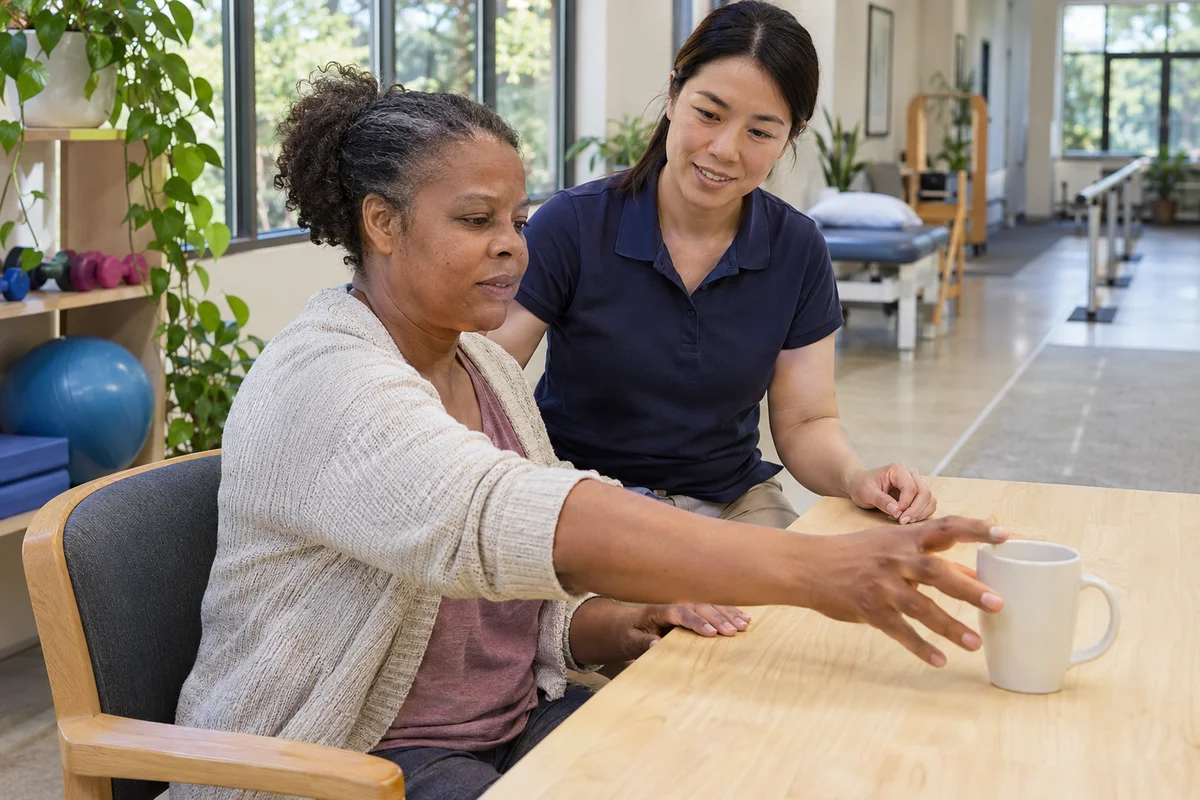
| Using the arm in daily life | Is reaching limited by movement range, strength or difficulty handling an object’s weight? | How does that limitation affect dressing, meal preparation or another chosen activity? |
| Returning to an everyday routine | Which movement demands need assessment and graded practice? | How can tasks, tools or the environment support participation? |
These are examples of questions, not exclusive boundaries or a prescription for a particular diagnosis. Ohio State’s patient comparison explains how the professions may collaborate, using getting up and dressing as an example.
A rule such as “PT is for legs, OT is for hands” misses this overlap. Both professions can address problems involving the arms, and both consider functional goals. Nor is the distinction simply “PT does exercises, OT uses tools”: an actual plan can include several approaches. The useful comparison is how the assessment findings and selected practice fit the person’s task.
How do you decide where to start?
The obstacle guides the starting assessment: movement or physical-capacity limitations may call for PT; difficulty completing daily tasks or using the environment may call for OT. Interacting difficulties may need coordinated care. Describing pain with reaching, balance trouble or handling a fastening helps identify the task without self-diagnosing.
If you already have a diagnosis or a recent operation, bring the treating team’s instructions. A general comparison should not override surgical restrictions or determine the correct specialist for a new or unexplained medical problem. When uncertain, describe the difficulty to your medical clinician rather than selecting care only from an online label.
What if you need both PT and OT?
PT and OT can have complementary activity goals. Each plan identifies the part it addresses, the practice between visits and how the instructions fit together. Current restrictions need to be shared, and apparently conflicting instructions should be coordinated before practice.
For instance, a plan may separate the capacity needed to reach from the practical steps needed to complete dressing. Progress in one area does not automatically settle the other. Being able to raise an arm in the treatment room and being able to manage a morning routine are related, but different, observations.
Keep a short record of what remains difficult, help or equipment used, and any symptom response. Bring unclear instructions back for review. Our rehabilitation guide explains how assessment, home practice and review connect to daily goals.
What should you bring to the assessment?
Bring relevant reports, medication information, existing therapy plans and any restrictions from your medical team. Describe the actual task and setting: what you are trying to do, when difficulty appears, whether you need another person’s help and which approach you have already tried.
The plan identifies the main obstacle, what the chosen therapy will address and the instructions for the time between visits. Progress is compared through the same daily task, including how much help is needed and whether it becomes easier or more independent. If another professional assessment is needed, the treating team can help clarify the appropriate pathway.
Confirm the service and the office’s ability to address the requested need before booking. Insurance benefits, referral and authorization requirements should be checked for the specific service and plan; the words rehabilitation, OT and PT should not be treated as interchangeable billing labels.
Understanding the appropriate next assessment
Wongs Acupuncture & Angel Alliance Physical Therapy offers physical therapy in Manhattan, Forest Hills and Great Neck. An initial PT visit is approximately 75–90 minutes. Bring your activity goal and ask the chosen office to check relevant insurance requirements. If you need occupational therapy, confirm an appropriate provider with your treating team. For a pain concern, a separate acupuncture consultation can also be discussed according to the assessed problem.
OUR LOCATIONS
Choose a clinic.
Choose a convenient location to discuss your needs or arrange a visit.