
HEALTH JOURNAL
The Pilates Roll-Up: Why It Can Be Difficult and How to Start Smaller
Dr. Wei (Sean) Li · · Updated
The Pilates roll-up is a controlled movement from lying on your back toward sitting and a forward curl, followed by a controlled return. If you cannot complete it smoothly, a smaller version and clear instruction are more useful than throwing your arms forward or forcing your back. A full straight-leg roll-up is not a required test of fitness.
This guide explains a named Pilates skill for generally healthy adults who can safely use a floor mat. It is not a rehabilitation exercise prescription for back pain, pregnancy, a recent operation or a fracture. Symptoms and medical restrictions can change whether the movement belongs in your program.
On this page
Why is rolling up harder than it looks?
The exercise asks you to coordinate your head, trunk, arms and legs while your body’s weight shifts. Arm position changes the leverage: keeping the arms far overhead leaves more weight toward the head end, while bringing them forward as the trunk curls changes that distribution. Moving quickly may get you upright, but it does not teach the same controlled movement.
In Merrithew’s roll-up teaching discussion, a STOTT Pilates Master Instructor describes body proportions, lower-back flexibility and hip-flexor length and strength as factors that may affect execution. Hip flexors are muscles that help bring the thigh and trunk toward one another. She suggests half-roll preparations among the possible teaching options.
That does not diagnose why you personally find it difficult. A person watching your movement can distinguish an unclear instruction from a task that needs a different starting version. The Polestar explanation of the roll-up also emphasizes leverage and individual observation. Failing to sit up is not proof that your spine is damaged or that you simply need to work harder.
What does a bent-knee modification involve?
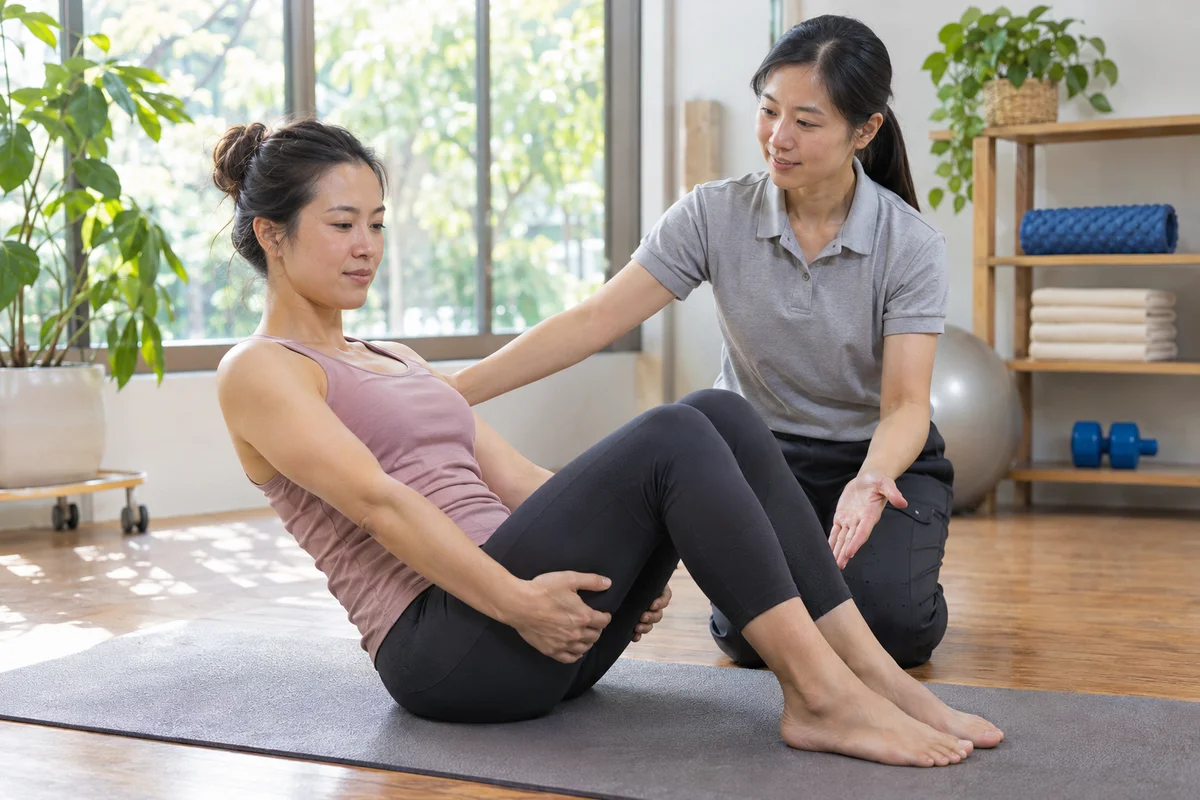
BASI Pilates instructor Lisa Hubbard’s public roll-up tutorial demonstrates a version using bent knees and the hands at the thighs. The outline below follows that version. Have an instructor help you learn it if the setup or return is unclear.
- Set up on the mat. Lie on your back with your legs together, knees bent and feet resting on the mat. The demonstrated starting position has the arms reaching overhead. Use a comfortable range; do not force the shoulders into that position.
- Begin the curl. Bring the arms upward and look toward your thighs. Use your hands at your thighs to assist as you curl upward, rather than flinging the arms to gain momentum. The tutorial uses an exhalation during this part.
- Move toward sitting. As the trunk comes up, the demonstrated version gradually lengthens the legs and reaches forward. Keep the movement manageable. Do not turn reaching toward your feet into a forced stretch.
- Learn the return. Roll back with control, bending the knees again as you lower toward the mat. Let the arms return comfortably overhead when the body is supported. The return deserves as much attention as getting upright.
You do not need to copy every variation in the tutorial. It also shows bands and ankle weights; those are separate teaching choices, not equipment you should automatically add. Do not improvise an anchor or weight the legs simply to force a full roll-up.
What if this version is still too difficult?
Stop before momentum or straining takes over. An instructor may select and demonstrate a half roll-up or half roll-back as a starting version. A smaller preparation is not a failed full exercise; it provides an understandable, repeatable task.
For example, you may need help coordinating the start before adding a larger range, or you may understand the upward movement but lose control on the return. Those are different teaching problems. Tell the instructor which part is unclear instead of assuming every difficulty comes from weak abdominal muscles.
If you are new to floor practice altogether, our beginner home Pilates guide introduces a starting position and three other basic movements. You do not have to begin with a roll-up.
How can you judge useful practice?
Look for a clearer setup, steady breathing and a movement you can stop and reverse comfortably. More range or more repetitions do not help if the return becomes uncontrolled. Learn one change at a time so you can tell whether it improved the movement.
Swinging arms, unexpectedly lifting legs or holding the breath identifies technique to review with an instructor, rather than a self-diagnosis. Practice the most relevant correction first before adding another cue.
When should the exercise be adapted or left out?
Stop if movement causes pain or makes you unwell. Get appropriate advice when a health condition, symptoms, pregnancy or recent surgery affects exercise suitability. A general fitness tutorial cannot clear a medical restriction.
Osteoporosis and spinal-fracture history need particular care. The US Bone Health & Osteoporosis Foundation explains that some forward-bending exercises may increase spinal-fracture risk. The Royal Osteoporosis Society’s movement guidance also explains that normal bending is part of everyday movement, while some exercises need adapting to reduce pressure on the spine.
A smaller roll-up still involves spinal bending and is not automatically suitable. A professional can select a suitable alternative; this tutorial is not an osteoporosis routine.
Individual movement feedback
Wongs Acupuncture & Angel Alliance Physical Therapy offers one-to-one Medical Pilates and postural training in Manhattan and Great Neck. Instruction can focus on the movement step that needs help. When pain or injury is the main concern, a physical therapy assessment can help establish an appropriate starting plan.
OUR LOCATIONS
Choose a clinic.
Choose a convenient location to discuss your needs or arrange a visit.