
HEALTH JOURNAL
Yin and Yang in Chinese Medicine: Balance and Everyday Food Choices
Ben Wong · · Updated
In Chinese medicine, yin and yang describe related, contrasting aspects of a situation and how they depend on and influence one another. They are a way of organizing traditional thought, rather than two substances measured by a blood test. “Balance” means an appropriate, changing relationship; it does not mean that everything should stay half yin and half yang.
Yin or yang is always relative to a particular comparison: warmer or cooler, more active or more restful. Keeping that comparison clear helps distinguish a traditional explanation from a medical diagnosis or a treatment claim.
On this page
- What do yin and yang actually describe?
- How do the two sides relate?
- Does balance mean equal amounts?
- What are cooling and warming foods in Chinese medicine?
- Does feeling hot or cold identify my pattern?
- Can a yin–yang explanation tell me which treatment to choose?
- How do these concepts fit an individual care plan?
- Connect the explanation with everyday care
What do yin and yang actually describe?
Yin and yang refer to contrasting attributes of related things, or to two corresponding aspects of one thing. The Beijing TCM authority’s explanation of their meaning (Chinese) emphasizes relatedness, correspondence and the particular attribute being compared. The terms are not useful labels for any two unrelated objects.
Light and shade, warmth and coolness, and upper and lower illustrate the idea. In a comparison of temperature, warmth is associated with yang and coolness with yin. You cannot arbitrarily reverse those meanings while keeping the same comparison. However, a label does not make an object permanently yin or yang in every possible respect.
Consider a sheltered place that is cooler than a sunny pavement but warmer than an icy surface. The description changes with the comparison. This is an ordinary illustration of relative attributes, not a test of a person’s constitution or a medical explanation for feeling cold.
How do the two sides relate?
Beijing University of Chinese Medicine’s teaching article on yin–yang relationships (Chinese) explains three useful ideas: opposition and restraint, mutual dependence, and growth and decline within a dynamic balance. They describe relationships, rather than a list of things everyone should add to or remove from their life.
| Traditional idea | Plain-language meaning | An everyday illustration |
|---|---|---|
| Opposition and restraint | The contrasting aspects influence and limit one another. | Warming and cooling pull a temperature comparison in different directions. |
| Mutual dependence | The two aspects depend on, and can support, one another. | In traditional reasoning, nourishment supports activity, while activity helps use and distribute nourishment. |
| Growth and decline | The relationship changes over time rather than remaining fixed. | From spring toward summer the seasons become warmer; from autumn toward winter they become cooler. |
These examples help explain the vocabulary. They do not demonstrate that a particular symptom is caused by a yin–yang imbalance, or that one treatment will correct it. A metaphor about the seasons should remain a metaphor when discussing a patient’s health.
Does balance mean equal amounts?
No. In this framework, balance is relative and dynamic. The university explanation specifically describes ongoing change within limits. A drawing with two equal-looking halves is not a prescription for equal quantities of sleep and activity, hot and cold food, or two types of medicine.
An actual excess and a relative predominance are different ideas. The Beijing explanation contrasts two traditional descriptions: an external cold influence may impair the body’s warming function, whereas a decline in its own nourishing and cooling aspect, called yin deficiency, can make yang appear relatively more prominent. One describes an added influence; the other describes reduced support. The same words therefore need their surrounding explanation.
In a consultation, the term needs to connect to the actual symptom pattern and treatment principle. A traditional pattern, a symptom feature and a proposed therapy are different parts of the explanation; understanding them in ordinary language makes the next step clearer.
What are cooling and warming foods in Chinese medicine?
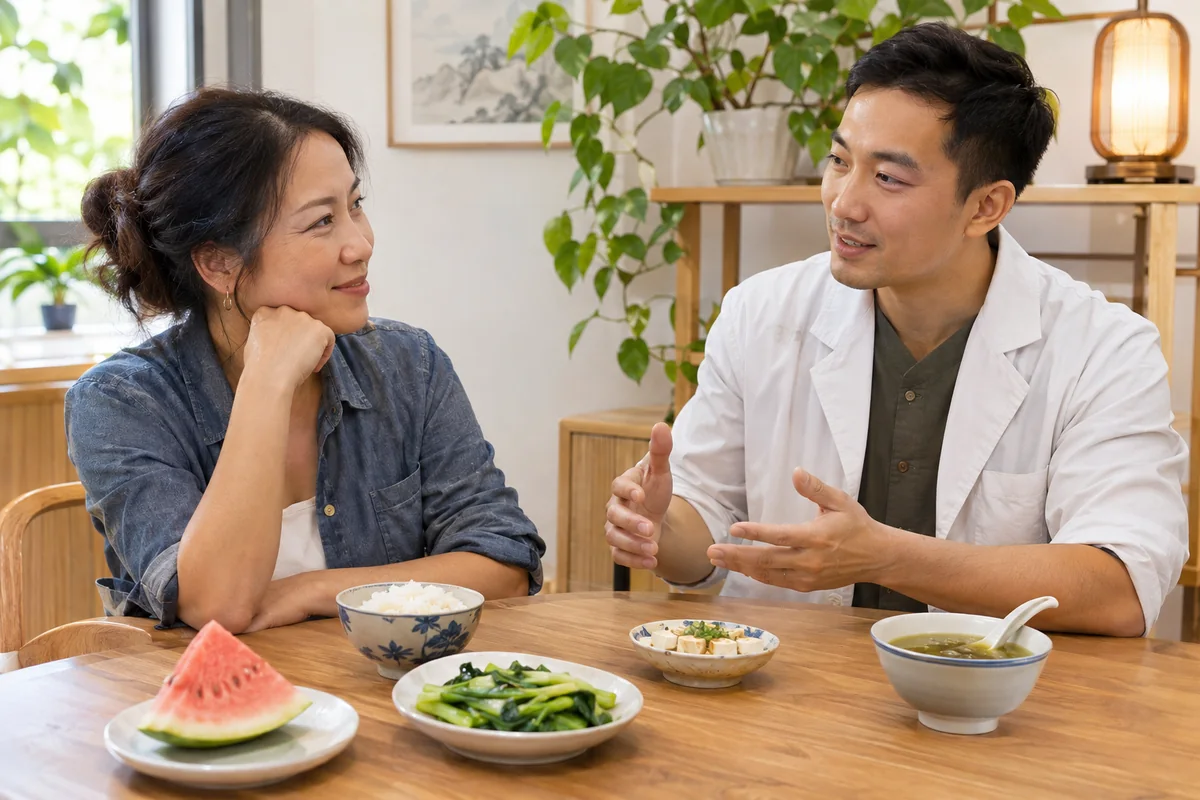
In Chinese medicine, “cooling” and “warming” describe a food's traditional nature, not simply the temperature at which it is served. The four natures are cold, cool, warm and hot; foods with a milder nature are called neutral. The Hong Kong Department of Health food guide gives these examples.
| Traditional group | Examples from the guide |
|---|---|
| Cold or cool | Mung beans, Chinese celery and watermelon |
| Warm or hot | Chives, lamb and chilli |
| Neutral | Rice, soybeans and carp |
A bowl of mung-bean soup can be served warm while mung beans are described as cooling in this framework. Food temperature, cooking method and traditional classification are separate details. A cooling label also does not mean that a food measures or lowers your core body temperature.
Use the examples to understand the terminology and keep ordinary meals varied. A rice, vegetable and protein meal does not need a precise yin-to-yang ratio. Choosing a comfortable serving temperature or cooking vegetables can make meals easier to enjoy without turning a food list into a rigid ban on whole groups.
Feeling warm once does not establish a “heat” pattern, and cold hands alone do not establish a “cold” pattern. Persistent digestive trouble, unintended weight loss or a medically prescribed diet needs individual guidance. Dietary advice can fit your appetite, usual meals and existing care rather than replacing them with a universal cooling-food menu.
Does feeling hot or cold identify my pattern?
A single observation is not enough to assign yourself a pattern. A traditional assessment considers features together: what happens, when it happens, sleep, appetite, other symptoms and observations made during the consultation. The same broad complaint can lead to different follow-up questions.
For example, imagine two people who both say they feel tired. One reports disrupted sleep; the other emphasizes poor appetite and bloating. The useful next step is to clarify those differences and any medical assessment already completed. This example does not diagnose either person or establish that yin or yang explains their fatigue.
Traditional organ terms also need context. A phrase involving Kidney or Liver in a TCM pattern is not interchangeable with a diagnosis of disease in that anatomical organ. Bring actual diagnoses and reports rather than replacing them with a traditional label. Our TCM consultation guide explains these distinctions and preparation in more detail.
Can a yin–yang explanation tell me which treatment to choose?
It can explain a traditional line of reasoning, but it does not by itself establish that a treatment is effective or suitable. Those questions concern the actual intervention, health problem, risks and alternatives. The NCCIH TCM overview examines individual approaches and their evidence and safety, rather than treating TCM as one uniform intervention.
Similarly, a “yin” or “yang” food list is not an individualized nutrition plan. It does not account for all the reasons someone may need dietary advice. Do not change medicines or start a concentrated herbal product simply because an online description seems to match you. If herbs are proposed, review the actual ingredients, medicines and health history through a separate herbal-consultation discussion.
How do these concepts fit an individual care plan?
A useful explanation connects the traditional pattern with the actual concern, its timing and the activity it affects. A laboratory finding, a TCM pattern and the person's experience remain distinct information. The plan then states the proposed care and which symptoms or activities will be reviewed afterward.
Understanding the terminology should make care easier to follow. You do not need to identify your own constitution, follow a restrictive routine or choose every TCM service before receiving individual guidance.
For recurring bloating or an inconsistent appetite, a useful discussion connects ordinary meals with symptoms and any medical advice already in place. Individualized TCM guidance can focus on a few manageable changes that fit familiar foods, rather than replacing meals with a restrictive list.
Connect the explanation with everyday care
You can use the existing acupuncture service guide to understand a needling appointment and confirm the appropriate office and practitioner. If pain is your concern, an acupuncture assessment can be discussed in relation to that problem and your current care. Individual insurance benefits need to be checked before booking.
OUR LOCATIONS
Choose a clinic.
Choose a convenient location to discuss your needs or arrange a visit.