
HEALTH JOURNAL
Acupuncture for Knee Pain
Ben Wong · · Updated
Acupuncture can reduce pain and stiffness associated with knee osteoarthritis and improve activities such as walking, rising and using stairs.
Knee pain has several causes. The research focus here is diagnosed knee osteoarthritis, also called degenerative knee arthritis; other knee problems follow their specific assessment.
On this page
- Does Acupuncture Help with Knee Pain?
- How Effective Is Acupuncture for Knee Pain?
- Is Acupuncture Backed by Science?
- What You Should Know Before Booking an Acupuncture Treatment
- How Do You Know If Acupuncture Is Working?
- How to Get Acupuncture for Knee Pain at Wongs Acupuncture
- Final Thoughts About Acupuncture & Knee Pain
- Sources
Does Acupuncture Help with Knee Pain?
Yes. Acupuncture can reduce pain and stiffness associated with knee osteoarthritis and improve activities such as walking, rising and using stairs. Treatment is coordinated with the knee assessment, personal goals and movement or strength training.
This guide focuses mainly on knee osteoarthritis. NIAMS explains that osteoarthritis involves changes in cartilage, bone and other joint tissues, including the joint lining and meniscus; it is more than a simple account of worn cartilage. Pain and reduced activity can also contribute to muscle weakness. A new injury, unexplained swelling or another cause of knee pain still needs its own assessment.
What benefits can acupuncture offer for knee pain?
Practical benefits include less pain and stiffness and more comfortable walking, rising or stairs. Choose one or two important activities as shared treatment and review goals.
Acupuncture is a non-drug care option that can be coordinated with existing medicines and rehabilitation. Prescription changes are guided by the responsible clinician.
How does acupuncture help relieve pain?
Acupuncture uses fine needles at selected locations, with manual stimulation or small electrical currents in electroacupuncture. NCCIH describes effects involving nervous-system function and local tissues, alongside expectation and the practitioner relationship.
A useful treatment plan connects symptom relief with the activities you want to regain. Record how the knee feels during a familiar walk, on stairs or after sitting, and discuss how long a change lasts. Review those observations alongside exercise, medicines and other care so the next step reflects your overall progress.
Knee pain and swelling need the right diagnosis
A painful knee can have several causes, including osteoarthritis, an injury, tendon problems, bursitis, gout or infection. MedlinePlus’s knee-pain guide explains these differences and the role of history and examination.
A hot or red knee with fever or feeling unwell also needs prompt assessment. Routine acupuncture should not delay that evaluation.
Reducing discomfort and treating the underlying problem are related but different goals.
How does TCM distinguish knee Bi patterns?
The Chinese Association of Chinese Medicine osteoarthritis material (Chinese) describes Bone Bi through obstruction and insufficient nourishment. Qi refers to functional activity and Blood also has a nourishing role. Liver/Kidney functions include tendon/bone support, not a diagnosis of liver or kidney disease. Five related pattern families distinguish treatment aims:
| Traditional pattern | Features considered together | Traditional aim |
|---|---|---|
| Cold-Damp obstruction | Cold-aggravated aching, heaviness and stiffness. | Warm and ease obstruction. |
| Damp-Heat obstruction | Hotter, swollen discomfort with Heat features. | Clear Heat and Dampness. |
| Phlegm with stasis | Longstanding fixed or stabbing pain and stiffness. | Promote movement and address Phlegm/stasis. |
| Qi/Blood deficiency | Dull aching, numbness and fatigue. | Support Qi and nourish Blood. |
| Liver/Kidney deficiency | Longstanding knee/low-back weakness and impaired movement. | Support traditional tendon/bone nourishment. |
Deficiency can coexist with Cold-Damp or stasis, so the main and accompanying features influence needling and any separately assessed herbal or warming approach. Review stiffness, the same walking task and unwanted responses, as well as the wider pattern. A newly hot swollen knee needs medical assessment before assigning a routine Damp-Heat label.
How nearby and more distant points relate to a knee goal
Zusanli and Yanglingquan illustrate traditional lower-limb choices. Zusanli has nourishing and channel-related uses, while Yanglingquan is described through sinews and joints, explaining its relevance to movement-focused care. Zusanli (Chinese) Yanglingquan (Chinese)
The practitioner selects local points, distant points or both using symptoms, traditional findings, experience, preferences and response. The same leg point is nearby for a knee concern and distant for a shoulder concern. Published correction
How Effective Is Acupuncture for Knee Pain?
A 2026 trial involving 480 people with knee osteoarthritis found better pain, stiffness and function after six weeks of electroacupuncture than sham. The between-group advantage was 40.56 points on the 0–240 WOMAC symptom and function scale. These outcomes concern less pain and easier activity.
Which aspects of knee arthritis does acupuncture address?
Acupuncture primarily addresses pain, stiffness and activity difficulty. More comfortable walking, rising and stairs can be coordinated with appropriate strength, balance and movement training to support daily function. 2026 electroacupuncture trial
Keep acupuncture within a broader knee care plan
For knee osteoarthritis, the ACR’s 2026 guideline summary strongly recommends exercise and, for people who meet criteria for overweight or obesity, weight loss. It also advises education and self-management, and referral to PT when function, pain or fatigue limits exercise or daily activity. These foundations remain important if you choose acupuncture.
If walking, balance or strength is limiting you, discuss an individualized movement plan with a qualified clinician. You can learn about our physical therapy services and compare the wider options in our guide to nonpharmacological pain management.
Is Acupuncture Backed by Science?
A 2026 trial at six Shanghai hospitals enrolled 480 people with knee osteoarthritis and compared six weeks of electroacupuncture with sham, followed by continuing follow-up. WOMAC scores assessed pain, stiffness and activity difficulty, with results supporting symptom and functional benefits. Study or professional source
What You Should Know Before Booking an Acupuncture Treatment
The first visit reviews symptoms, diagnoses, medicines and activity goals before explaining the treatment and comfortable positioning. Bring relevant reports and a medicine list so acupuncture can be coordinated with existing care.
What to expect at an appointment
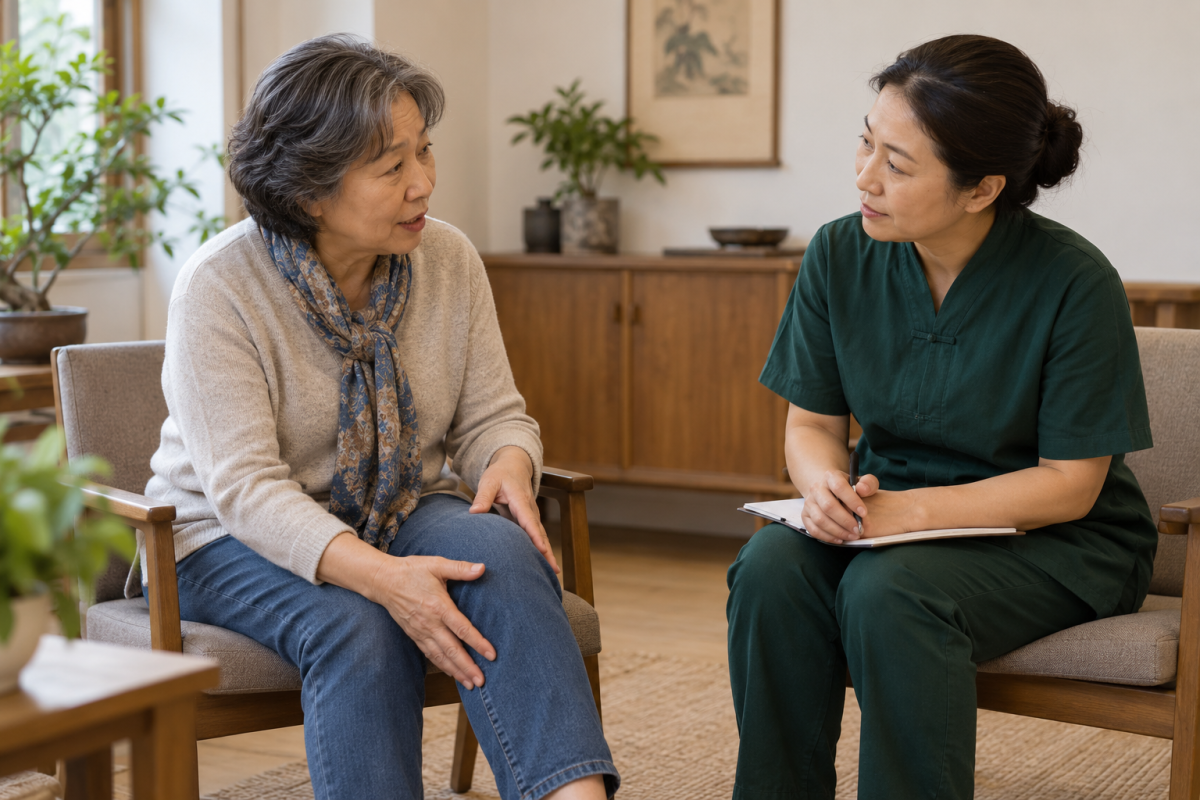
An initial discussion covers symptoms, diagnosis, medical history and previous treatment. The practitioner selects the approach and sites, which may be near the knee or elsewhere, and explains consent and feedback. You may sit or lie in a supported position while fine sterile single-use needles are placed. UCLH’s patient guide describes the procedure and health information to disclose. You do not need to choose points from a chart or perform self-needling.
Before treatment
Bring your diagnosis, medication list and any relevant treatment information. Explain the activity that bothers you most and whether symptoms are changing. “I stop halfway through my usual walk” gives the consultation a clearer starting point than a pain score by itself. You do not need to diagnose the knee yourself or repeatedly perform the most painful movement to demonstrate the problem.
Tell the practitioner about blood-thinning medicine, a bleeding disorder, pregnancy or possible pregnancy, a pacemaker or other implant, and changes in your health. These details can affect treatment planning; they are not all automatic reasons to rule out acupuncture. UCLH’s patient information explains the health information to disclose before a session.
During and after treatment
Fine needles can produce brief aching, warmth or heaviness, and temporary soreness, small bruises or drowsiness can follow. Report significant discomfort, dizziness or increased pain so the practitioner can assess and adjust care. Read about common reactions to acupuncture
The initial frequency and review point are planned around pain, activity goals and comfort. Continuing treatment is refined around improvements in walking, rising and stairs.
Safety and care arrangements
Treatment uses sterile, single-use needles and professional training to support appropriate care. NCCIH’s acupuncture guidance describes the FDA requirements for sterile, single-use needle labeling. Before treatment, review your health history, medicines and comfort preferences with the practitioner. NCCIH’s acupuncture safety guidance
The assessment and follow-up have a clear purpose:
Assessment connects the knee diagnosis with pain and activity goals. Follow-up uses the same activity to review progress and coordinate the next step across acupuncture, rehabilitation and other care.
The appointment combines a review of your knee symptoms, an explanation of appropriate care and time to understand the plan. Our team information introduces the practitioners and their roles. Insurance benefits are checked for the actual service and office, separately from confirming the appointment time. An initial acupuncture visit is usually about 75–90 minutes.
Choosing a method you can comfortably receive
Our primary method is manual acupuncture, and we also offer electroacupuncture and auricular acupuncture. Electroacupuncture adds electrical stimulation through needles; auricular acupuncture uses needles in the ear. The practitioner selects the approach around treatment goals, health findings and comfort.
For patients who prefer a needle-free approach, ear seeds use adhesive patches to hold small seeds or beads over ear points for pressure stimulation. Auricular acupuncture uses needles, while ear seeds provide needle-free stimulation. Tell the practitioner about skin discomfort from the adhesive or pressure so it can be adjusted.
An initial acupuncture or physical therapy appointment is approximately 75–90 minutes; combining the services takes somewhat longer. The practitioner explains needle-retention time and plans subsequent visits and review around treatment goals, progress and comfort.
Seek prompt medical assessment for a newly hot, red or markedly swollen knee, fever or feeling unwell, or inability to bear weight after an injury.
How Do You Know If Acupuncture Is Working?
A more comfortable walk, easier rising and less knee pain on stairs are useful improvements. Recording pain, stiffness and activity tolerance separately helps coordinate acupuncture with rehabilitation.
Track progress in ordinary activities
Use the same walk, stairs or chair to record improvements in pain and activity. A short record helps the practitioner plan the next stage:
| What to record | An example |
|---|---|
| Pain during a familiar activity | Discomfort during the same short walk or flight of stairs. |
| What you can do | Whether you can rise from your usual chair or complete a regular errand more easily. |
| How long any relief lasts | Whether a change continues later that day or into the following days. |
| Other changes in care or activity | A new exercise, medication change, physical therapy session or unusually demanding day. |
| Unwanted effects | Bruising, dizziness, increased pain or a new symptom to discuss. |
Compare similar activity conditions and describe changes in exercise, medicines and daily load to help coordinate treatment.
The practitioner uses pain relief, easier activity and recovery response to refine points and continuing rehabilitation.
Discuss a movement plan that fits your knee
A movement plan connects symptom relief to a functional goal. The assessment can distinguish restricted knee bending or straightening, available movement that is hard to control, and a task limited by strength or endurance. The thigh muscles help straighten and control the knee, while hip muscles contribute to leg control. Someone struggling to rise from a chair may need a different start from someone who walks comfortably but loses control on stairs.
The AAOS knee-conditioning program includes supported half-squats and knee-extension work as examples of strengthening. After assessment, a shallow squat with a stable chair for balance may be used to practice controlled lowering and rising; its depth, support and amount are chosen for the person. Seated knee straightening may provide a different starting load. These are examples to discuss and demonstrate, not a program for an unassessed injury or newly swollen knee.
Usable instructions specify the movement range, support, resistance, repetitions and rest, and the response that calls for adjustment. The clinician demonstrates and checks your performance, including a practical home alternative if equipment differs. Progression may reduce support, increase a comfortable range or resistance, or build a task’s duration, according to control, symptoms and recovery.
At review, discuss both the planned activity and the knee’s response afterward. Share the same goals with the clinicians involved in your care, so symptom relief, exercise and any other treatment support a coherent return to daily activity.
How to Get Acupuncture for Knee Pain at Wongs Acupuncture
To discuss whether needling fits your diagnosis and goals, explore acupuncture at Wongs Acupuncture & Angel Alliance Physical Therapy. Acupuncture is available at our Manhattan, Forest Hills and Great Neck clinics. Choose a convenient location below for contact details and appointment options, and bring your current care plan to the discussion.
Final Thoughts About Acupuncture & Knee Pain
Acupuncture care for knee pain can be planned around specific symptoms and everyday goals. Contact the most convenient clinic with the diagnosis, current care and the main concern you want to improve so the team can arrange consultation and continuing treatment.
Sources
- Osteoarthritis Symptoms, Causes & Risk Factors | NIAMS
- Acupuncture: Effectiveness and Safety | NCCIH
- Knee pain: MedlinePlus Medical Encyclopedia
- 膝痹的中医辨证 — 中华中医药学会科普标准知识库
- 足三里穴_足三里穴的效果作用| 中国医药信息查询平台
- 阳陵泉穴_阳陵泉穴的效果作用| 中国医药信息查询平台
- Corrigendum to “Electroacupuncture for knee osteoarthritis: a multicentre randomised controlled trial assessing symptomatic and structural efficacy” - PMC
- Electroacupuncture for knee osteoarthritis: a multicentre randomised controlled trial assessing symptomatic and structural efficacy — 2026
- Summary: 2026 Osteoarthritis Guideline Posted September 14, 2026
- Having acupuncture : University College London Hospitals NHS Foundation Trust
- AAOS: Knee Conditioning Program
OUR LOCATIONS
Choose a clinic.
Choose a convenient location to discuss your needs or arrange a visit.