
HEALTH JOURNAL
Muscle Pain Relief After Exercise: Soreness and Recovery
Ben Wong · · Updated
For mild muscle soreness after exercise, start by reducing the workload and returning to comfortable movement as symptoms settle. The next step is different if pain began suddenly during a movement, is worsening, or has no clear connection to exercise. This guide focuses on workout recovery; for symptoms that keep returning, see our guide to treatment options for persistent or recurring muscle pain.
On this page
- Is this normal exercise soreness or a possible injury?
- What helps muscle pain after a workout?
- Does massage help sore muscles after exercise?
- Should you take a pain reliever?
- Build a more manageable return to exercise
- Separate a comfort decision from a training decision
- When should you get medical help?
- When soreness keeps interrupting your routine
- Sources and further reading
Is this normal exercise soreness or a possible injury?
Delayed-onset muscle soreness, usually shortened to DOMS, develops after challenging or unfamiliar activity. It commonly becomes noticeable one to three days later, affects the muscles you used, and fades over the following days. Sharp pain during a particular movement is a different pattern and should not automatically be dismissed as DOMS. See Cleveland Clinic’s explanation of delayed muscle soreness.
Unfamiliar demand can stress muscle fibers, especially while a working muscle lengthens, such as lowering a weight or walking downhill. Recovery involves adaptation to that demand. This helps explain why a new routine may feel different from your usual exercise; soreness itself is not a measure of how productive the workout was.
A muscle strain is an injury to a muscle or tendon and can range from overstretching to a tear. Swelling, weakness, bruising or difficulty using the area can accompany an injury. The American Academy of Orthopaedic Surgeons’ guide to soft-tissue injuries explains why a strain needs a different recovery plan from ordinary soreness.
| What you notice | A useful next step |
|---|---|
| Mild tenderness in recently exercised muscles, with a clear trend toward improvement | Reduce training demands and monitor how everyday movement feels. |
| Sudden pain during a lift, sprint or stretch, especially with swelling or reduced function | Stop the provoking activity and consider an injury assessment. |
| Aches throughout the body, symptoms after a medication change, or pain without a clear exercise trigger | Contact your healthcare professional instead of assuming workout soreness. |
These patterns help you describe symptoms; they do not establish a diagnosis. MedlinePlus’s muscle-ache guidance also identifies infections, medication effects and other medical conditions as possible causes.
What helps muscle pain after a workout?
Ease the workload while keeping movement comfortable
Take a break from hard exercise involving the sore muscles. Comfortable daily activities or a short, easy walk may be reasonable, but another intense session is not a recovery requirement. Cleveland Clinic recommends avoiding intense exercise with sore muscles while allowing ordinary movement as tolerated. Improvement after a comfort measure is not a reason to ignore pain or immediately repeat the same workout. Read its advice on activity during DOMS.
For example, if a new leg workout leaves you tender on the stairs, choose an easier day instead of testing whether you can reproduce your heaviest lift. Keep a simple note of which activity provoked symptoms and what you changed. That record is useful if the pattern keeps happening.
Use cold for a fresh injury; treat warmth as a comfort option
If you suspect a minor strain, the NHS’s initial strain-care guidance recommends protection, rest from the provoking activity, a wrapped ice pack, support and elevation during the first two to three days. Use the pack for up to 20 minutes at a time, with a cloth between it and the skin. Avoid heat and massage over a newly swollen injury during the first couple of days. Start gentle movement when pain no longer stops you.
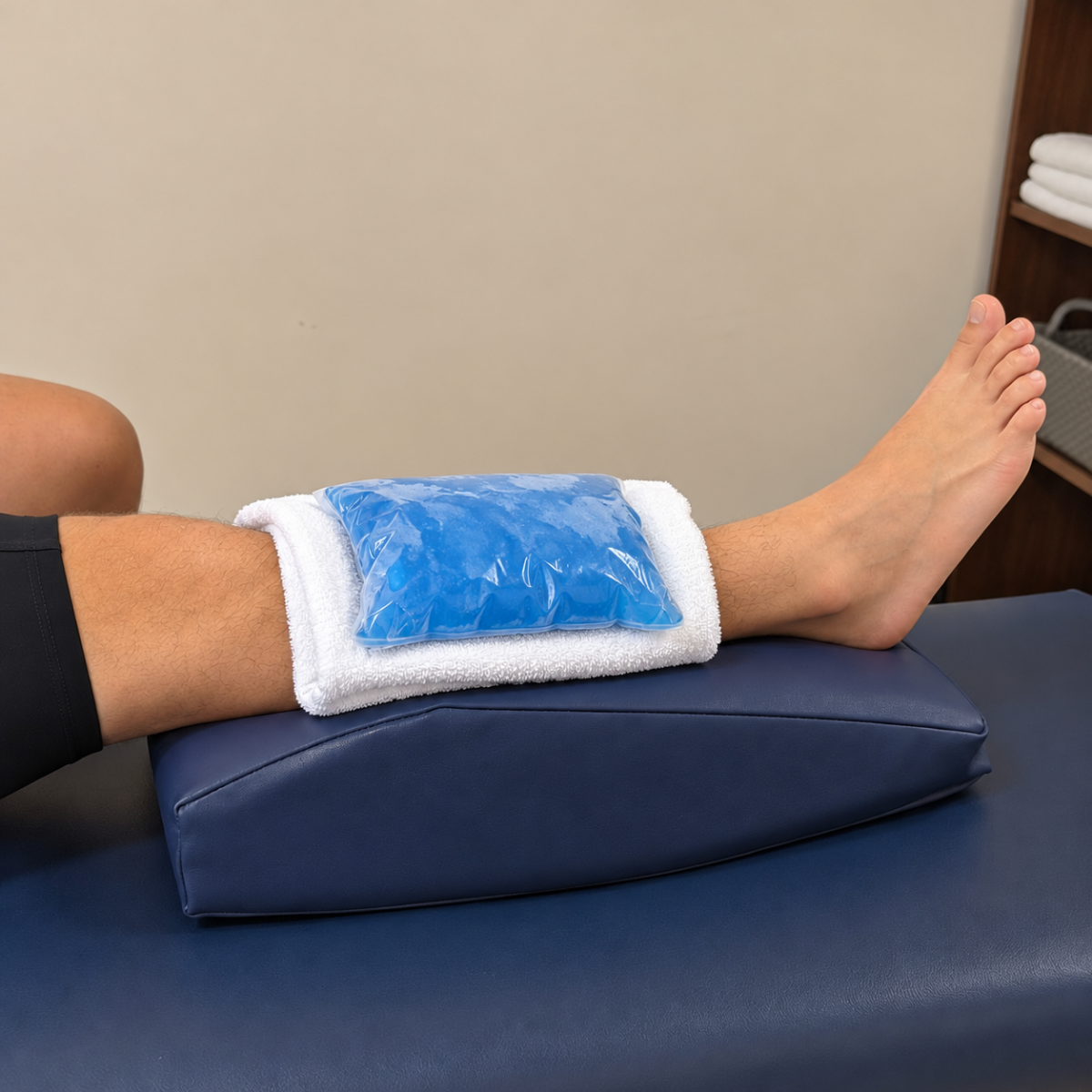
Once the early injury period has passed, warmth may feel more soothing for stiffness. It is a comfort measure, not a test of whether an injury has healed. MedlinePlus describes cold and heat for muscle aches.
Does massage help sore muscles after exercise?
Massage can reduce the feeling of DOMS for some people, but less soreness is not the same as repaired tissue or restored sporting performance. A 2020 systematic review of sports massage included 29 randomized studies with 1,012 participants. It reported small improvements in soreness and flexibility, while strength, jumping, sprinting, endurance and fatigue did not improve significantly. These were different performance and recovery outcomes, not a test showing that a comfortable athlete was ready to compete.
A 2025 umbrella review of physical treatments for DOMS searched through February 2024 and combined existing systematic reviews. It reported massage-related soreness reduction at 24, 48 and 72 hours after exercise. Those observations are about soreness at specific times, not a measured acceleration of tissue repair. Review comfort alongside ordinary movement, strength and training tolerance when deciding how to return.
If you are considering a medical massage appointment, explain the exercise, when symptoms appeared and whether there was a sudden painful movement. Massage works on soft tissues through strokes, kneading or selected pressure. The practitioner can adjust the area, position, pace and force to your history and feedback; speak up if pressure is sharp or makes you brace. Deep pressure is not required. A comfort-focused session and return-to-sport rehabilitation have different aims. NCCIH describes these hands-on approaches and safety considerations.
When should you avoid working directly on the sore area?
Do not treat a new swollen strain as ordinary workout soreness. The NHS advice above recommends avoiding massage over a fresh injury during the first couple of days. Unexplained swelling, significant bruising, marked weakness, a loss of normal function or pain that is worsening deserves assessment before direct pressure. The question is whether massage fits the problem, not how to find someone willing to press harder.
NCCIH’s massage safety overview notes rare reports of serious harms, including nerve injury, fracture and blood-clot-related problems; some involved vigorous techniques or people at increased risk. Tell the practitioner about blood-thinning medicines, fragile bones, recent surgery and relevant medical conditions. A known or suspected clot is not an area for massage.
If symptoms started after a massage rather than a workout, use our separate guide to soreness and warning symptoms after massage. The timing and decision are different. Do not automatically label either experience as toxins leaving the body, and do not add repeated treatments to an unexplained painful area before understanding what happened.
How do you decide whether it was useful?
Choose an ordinary task before the appointment: taking the stairs, walking a familiar distance or moving the affected area during daily work. Compare the same task afterward and the following day. Notice whether the change is useful in your routine, how long it lasts and whether unwanted tenderness makes the next day harder. A lower soreness score without better activity tolerance is a narrower benefit than being ready for a demanding workout.
Keep the return to exercise separate from the decision to repeat massage. For example, if your legs feel easier immediately after a session but you still struggle with normal stairs, that is not a reason to resume the heaviest leg workout. Discuss the training load and functional limitation rather than asking massage to compensate for a repeated recovery problem.
A brief note can keep the next discussion focused: the preceding activity, the response to massage, ordinary tasks that remain difficult and the next change being considered. If setbacks return after each training increase, a PT assessment can examine movement, strength and load progression. Acupuncture may be discussed for a separate assessed pain concern, with its own goals and review point; that is a different decision from managing ordinary improving DOMS.
Should you take a pain reliever?
Occasional over-the-counter medicine may reduce discomfort, but it should not become a way to train through worsening pain. Read the exact product label and ask a pharmacist which option fits your health history and other medicines. The FDA’s OTC pain-reliever guidance explains why exceeding the dose or labeled duration can be harmful.
- Acetaminophen: This is the usual US name for the medicine also called paracetamol. Check cold, flu and prescription products for the same ingredient; taking too much can cause serious liver injury. Follow the FDA’s acetaminophen safety advice.
- Ibuprofen and naproxen: These are nonsteroidal anti-inflammatory drugs, or NSAIDs. They can be unsuitable for some people. Dehydration is especially relevant after strenuous activity: the National Institute of Diabetes and Digestive and Kidney Diseases warns that NSAIDs can contribute to kidney injury when you are dehydrated.
If you regularly need medicine to get through workouts, review the cause and training plan with a professional rather than increasing the amount you take.
Build a more manageable return to exercise
The goal is to resume activity without repeatedly overwhelming the same tissues. AAOS’s injury-prevention guidance advises introducing unfamiliar activities cautiously, warming up, avoiding painful stretching, allowing rest and staying hydrated. A gradual return connects what you can manage now with the next training demand.
When recurring setbacks need PT, the findings guide the plan: restricted movement may call for a chosen mobility exercise, while early fatigue or poor control may call for a different starting load and practice. For example, after assessment, a lower step or chair-supported movement may be selected before a demanding stair workout. The therapist demonstrates the movement and checks your performance, specifying range, support, resistance, repetitions, rest and the response that calls for adjustment. Progression can change height, load or duration according to control and recovery, with an alternative you can reproduce at home. APTA’s pain guide describes assessment and an individualized movement plan.
Use a short recovery log to make decisions easier:
- Before activity: Note the location of discomfort and any swelling or difficulty with ordinary tasks.
- During activity: Record which movement brings symptoms on. Do not treat sharp or increasing pain as a target to work through.
- Afterward: Note whether walking, stairs or work tasks are becoming easier, unchanged or harder.
- At the next session: Bring repeated setbacks to your clinician or physical therapist instead of relying on a fixed online recovery schedule.
A productive workout does not have to leave you sore. Cleveland Clinic notes that DOMS is not required for training progress.
Separate a comfort decision from a training decision
Before restarting a demanding workout, distinguish ordinary improving soreness from a diagnosed injury with specific restrictions. A comfort measure can change how you feel without establishing what load is appropriate. If a clinician has given a return plan, use that plan instead of replacing it with a fixed number of rest days from an online article.
| Question | Useful information |
|---|---|
| What changed? | The exercise, load, duration or unfamiliar movement that preceded symptoms. |
| What is manageable now? | Ordinary movement and tasks that remain comfortable, without a maximum-effort test. |
| What still needs assessment? | Sudden injury, worsening pain, significant weakness or difficulty using the area. |
| What is the next step? | A tolerable return discussed in context, or an injury-specific assessment and restrictions. |
This checklist organizes a discussion; it is not a sports-clearance test. A lower soreness score after massage does not answer all four questions.
When should you get medical help?
Seek medical care immediately for unusually severe muscle pain, marked weakness or tea- or cola-colored urine after exertion. These can be signs of rhabdomyolysis, a serious muscle-breakdown condition. You do not need to have every symptom, and symptoms alone cannot confirm or rule it out. The CDC’s rhabdomyolysis guidance explains when urgent testing is needed.
Get prompt assessment if an injury is very painful, swelling or bruising is increasing, you cannot bear weight or use the area normally, or symptoms are not improving with initial care. Fever with a painful, swollen area also needs medical advice. See the NHS guidance on injuries that need assessment. Call 911 for a medical emergency, such as difficulty breathing or swallowing; MedlinePlus lists these emergency warning signs.
When soreness keeps interrupting your routine
If pain keeps returning, a physical therapy assessment can connect movement and strength findings to a realistic progression plan. A medical massage discussion focuses on an appropriate comfort goal. A separate acupuncture consultation can address an assessed pain concern. Tell the team which activity is difficult and how the pattern has changed.
For a fuller comparison, read our guide to recurring muscle-pain treatment and overview of non-drug approaches to pain management. The clinic options below provide a next step for nonurgent care.
Sources and further reading
- Cleveland Clinic’s explanation of delayed muscle soreness
- American Academy of Orthopaedic Surgeons’ guide to soft-tissue injuries
- MedlinePlus’s muscle-ache guidance
- NHS’s initial strain-care guidance
- 2020 systematic review of sports massage
- 2025 umbrella review of physical treatments for DOMS
- NCCIH’s massage safety overview
- FDA’s OTC pain-reliever guidance
- FDA’s acetaminophen safety advice
- National Institute of Diabetes and Digestive and Kidney Diseases warns that NSAIDs can contribute to kidney injury when you are dehydrated
- CDC’s rhabdomyolysis guidance
OUR LOCATIONS
Choose a clinic.
Choose a convenient location to discuss your needs or arrange a visit.