
HEALTH JOURNAL
Pilates for Older Adults: Choose a Starting Level That Fits You
Dr. Wei (Sean) Li · · Updated
Pilates can be an exercise option for older adults when the starting positions, support and challenge fit their current ability. Age alone does not identify the right class or exercise. The useful questions are what you want to practice, how you will get into and out of position, and whether symptoms or medical restrictions need attention first.
Research suggests Pilates may improve measured balance in some healthy older adults. That is different from proving that Pilates alone prevents falls. A suitable program also needs to fit the rest of your activity and any clinical advice you already have.
On this page
- What matters more than the word “senior”?
- What has research found about balance?
- Should you use a mat, chair or apparatus?
- How can you make the first session easier to understand?
- What counts as useful progress?
- How does Pilates fit into a wider routine?
- When should assessment come before general Pilates?
- Understanding an individual starting session
What matters more than the word “senior”?
Start with what you can comfortably manage today. Getting down to a mat, rising from a chair, reaching an arm overhead and staying in one position are different demands. A person who walks regularly but dislikes floor transfers may need a different setup from someone who is comfortable on the floor but unfamiliar with the movements.
Choose a practical learning goal: understanding a supported exercise, coordinating the arms and trunk, or moving through a manageable range. Explain your exercise experience, any falls or near-falls, and current pain or restrictions. A class title cannot provide that information to the instructor.
“Gentle” describes actual movements and pace, including standing, floor access, support and individual feedback. Low impact does not necessarily mean easy to enter, follow or leave safely.
What has research found about balance?
A 2023 systematic review of Pilates and older-adult balance included 20 studies with 930 participants. Its eligible population was healthy adults aged 60 and over, with programs lasting 4–18 weeks in the included studies. It examined static balance—holding a position—and dynamic balance—maintaining control while moving—and reported improvement in those balance measures.
These programs studied a defined population and training period. Someone who is frail, recovering from an operation or living with a condition that affects balance needs a starting level and support suited to that situation. A research schedule is not an individual training prescription.
A 2024 review of 39 studies involving 1,770 older adults found better static, dynamic and overall balance than control groups, but no advantage in the number of falls or fear of falling. Pilates was comparable with other exercise for these outcomes.
A better balance-test result is useful information, but it is not the same outcome as fewer actual falls or fractures. Pilates should not be presented as a complete fall-prevention program. If falls or changing walking balance are the concern, a clinical assessment serves a different purpose from choosing a fitness class.
Should you use a mat, chair or apparatus?
Choose by the setup you can manage and the instruction available. Mat work involves floor access and body-weight exercises. Apparatus may provide support or resistance, but a moving carriage and its settings require explanation. Equipment does not make every movement easier or more suitable.
Chair-supported exercise can be another format to explore. The NHS standing and chair-based Pilates information describes options for people who find getting down to the floor difficult; some movements are entirely seated. This is general exercise information, not a demonstration that chair Pilates prevents falls or a statement that every studio offers it.
Instruction covers safe transitions, stable support and a different position when needed. Our private Pilates guide explains individual instruction and mat/reformer differences. The actual format matters; “senior Pilates” does not describe the same session everywhere.
How can you make the first session easier to understand?
Learn the starting position before adding movement. A suitable version is demonstrated, explaining which part moves and which stays reasonably steady. Keep breathing rather than tightening everything at once.
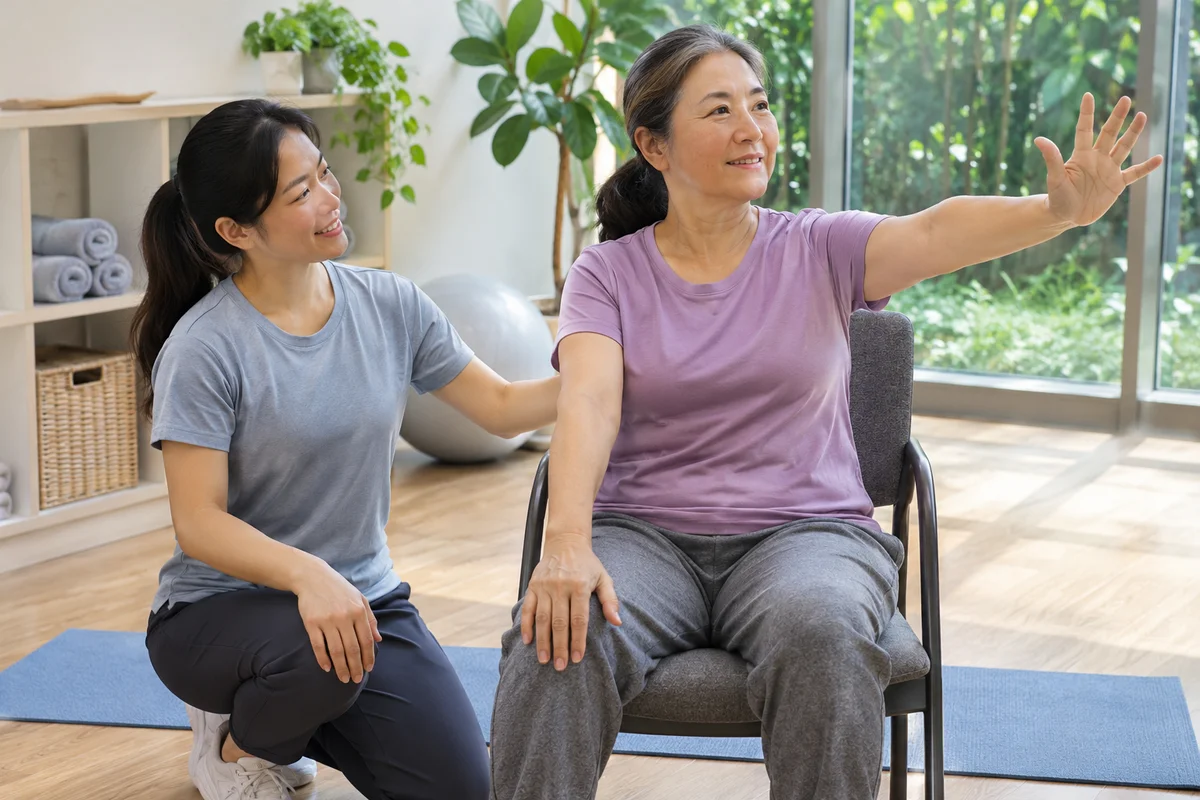
A supported position with a small arm movement may precede a larger movement when appropriate. This is a teaching example, not an exercise for everyone. One clear correction at a time helps learning; an unclear cue needs another explanation.
Explain practical barriers too: difficulty lying flat, an uncomfortable wrist position or uncertainty about getting up. A useful adjustment addresses the problem rather than requiring you to endure it silently.
What counts as useful progress?
Agree on something you can compare: whether the setup is clearer, whether you need fewer reminders, or whether an agreed movement is more controlled. If a daily activity is a goal, discuss whether any change carries over outside the session.
Include how you feel afterward. More repetitions, deeper positions or next-day soreness are not automatic signs of better training. If the exercise remains unclear, repeatedly aggravates symptoms or does not address the goal, review the starting version and type of support.
How does Pilates fit into a wider routine?
The CDC’s guidance for adults 65 and older includes aerobic activity, muscle strengthening and balance work. Its general weekly guidance includes 150 minutes of moderate aerobic activity, or 75 minutes of vigorous activity or an equivalent combination, plus muscle strengthening on at least two days and activities to improve balance.
These are overall activity goals, not a prescription to attend Pilates a certain number of times. Consider what the selected exercises actually train and what you do elsewhere. If you cannot meet the general recommendations, the CDC advises being as active as your abilities and conditions allow.
When should assessment come before general Pilates?
Get appropriate advice when a health condition, symptoms, recent operation or uncertainty affects exercise suitability. Stop a movement that causes pain or makes you unwell. Recent falls, new weakness, dizziness or a change in walking balance deserve clinical discussion rather than simply choosing a harder class.
Osteoporosis or spinal-fracture history may require specific movement changes. The US Bone Health & Osteoporosis Foundation explains that some forward-bending positions can increase spinal-fracture risk. The Royal Osteoporosis Society distinguishes ordinary movement from exercises that may need adapting. A smaller range or a chair does not automatically remove medical restrictions. A PT assessment and a fitness session have different roles.
Understanding an individual starting session
Wongs Acupuncture & Angel Alliance Physical Therapy offers one-to-one Medical Pilates and postural training in Manhattan and Great Neck. The starting plan considers your current ability, suitable support and relevant restrictions. The office confirms the actual appointment format and equipment; this article does not announce a senior group class or specialist falls program.
OUR LOCATIONS
Choose a clinic.
Choose a convenient location to discuss your needs or arrange a visit.