
HEALTH JOURNAL
Beginning Standing Pilates Without Turning Balance Into a Test
Dr. Wei (Sean) Li · · Updated
Standing Pilates is an adapted way to practice controlled movement in an upright position. It may be convenient for someone who prefers to avoid floor transfers, but standing is not automatically easier or safer. Balance, comfort, and a stable support determine whether it is a suitable starting format. This guide explains setup and selection, rather than prescribing a challenge or a rehabilitation protocol.
On this page
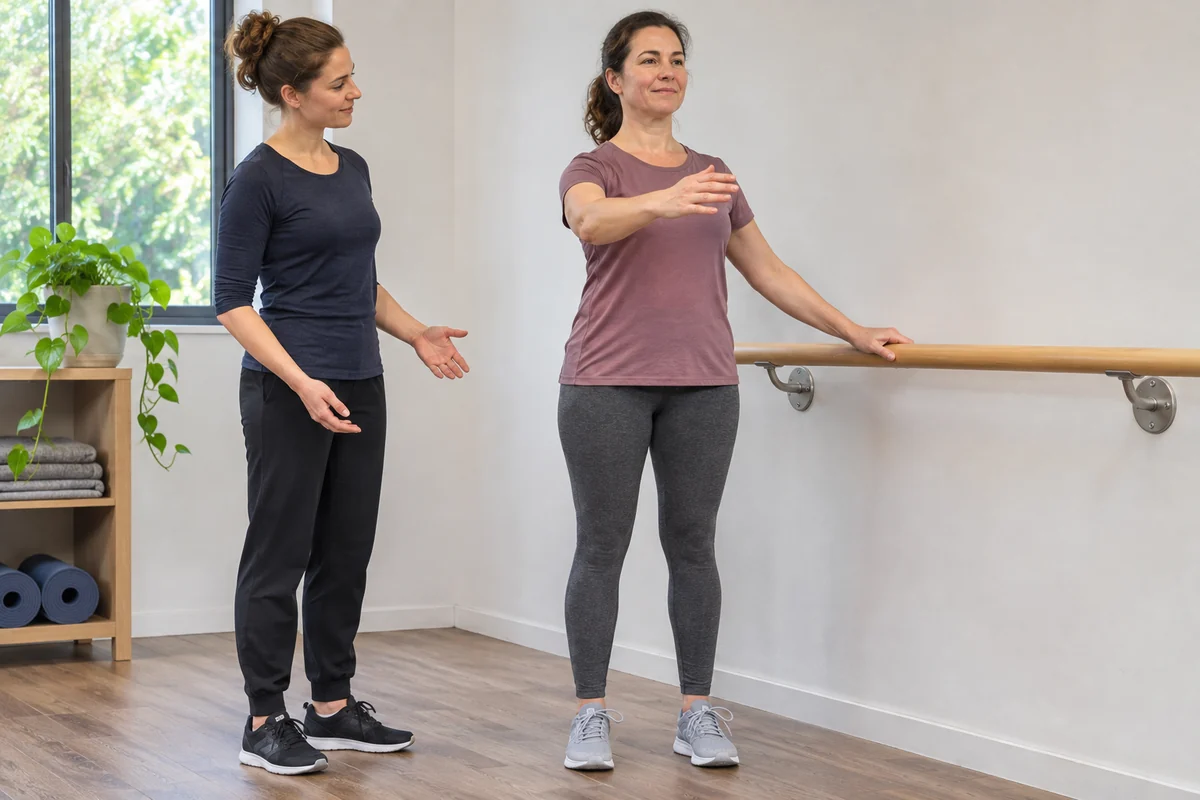
What remains Pilates when the position changes
Pilates commonly emphasizes control, attention to position and coordinated movement. Merrithew’s introduction describes these principles. Those learning aims can be used in standing practice without copying every floor exercise. An upright session should still have a clear task, such as learning a small weight shift or controlling an arm movement without losing balance.
The label does not promise weight loss, a particular body shape, or relief from every painful condition. It also does not make a standing routine equivalent to a full strength, aerobic, and balance program. Those are related but different activity goals.
Set up the support before beginning
Use a stable surface that will not slide or tip when touched. Mayo Clinic’s balance guidance gives a stable table or counter as examples of support. A light chair, a wheeled chair or an unsecured object is not dependable support. Clear nearby obstacles and allow room for an ordinary step. Avoid balancing on a soft or unstable surface simply to make a beginner session feel more advanced.
If standing requires another person's help, the activity needs an individualized level of supervision. Someone who is dizzy, faint, acutely unwell, or unable to stand safely should not begin an unsupported online routine. A seated or clinically supervised option may be more appropriate.
A small movement is enough to observe control
A supported beginning can focus on a comfortable stance and ordinary breathing before adding a small arm movement or weight shift. The aim is to notice whether the movement remains controlled without gripping more tightly than needed, holding the breath, or taking a hurried recovery step. It is an observation task, not a requirement to complete a set number of repetitions.
Here, a small weight shift can mean keeping both feet on the floor while gently moving a little more weight toward one side, then returning to an even stance before trying the other side. This is a supported preparation that an instructor can demonstrate and adjust; it does not require lifting a foot or holding a one-leg balance.
If a movement causes pain, unsteadiness, or dizziness, stop and reassess the choice. Making the action smaller may help some people, but repeatedly provoking the same symptom is not a learning goal. New or concerning symptoms need the appropriate clinical assessment.
Change one demand at a time
Reducing hand support, moving farther, going faster and adding repetitions are separate changes. Combining them all at once can make an otherwise manageable task difficult to control. An individual lesson can choose which variable to adjust and keep the others steady. Compare the agreed movement with the same support before deciding whether to reduce that support. The American Heart Association’s balance guidance also describes support as something to reduce gradually when steady.
For adults 65 and older, CDC guidance includes muscle strengthening and balance activity alongside aerobic movement. A short standing practice may be one part of that broader picture, adapted to current abilities. It should not be presented as a complete substitute for the other components.
Choose the format around the real barrier
If the barrier is getting to the floor, standing may be worth considering. If the barrier is balance or pain, physical therapy and a specific daily mobility assessment can help establish a more appropriate starting point. At Wongs Acupuncture & Angel Alliance Physical Therapy, the private Pilates page explains individual instruction. Our Pilates at home for beginners guide covers general home setup; a bed workout, an exercise PDF, and a Reformer routine are separate choices rather than interchangeable standing programs.
OUR LOCATIONS
Choose a clinic.
Choose a convenient location to discuss your needs or arrange a visit.